In the works…
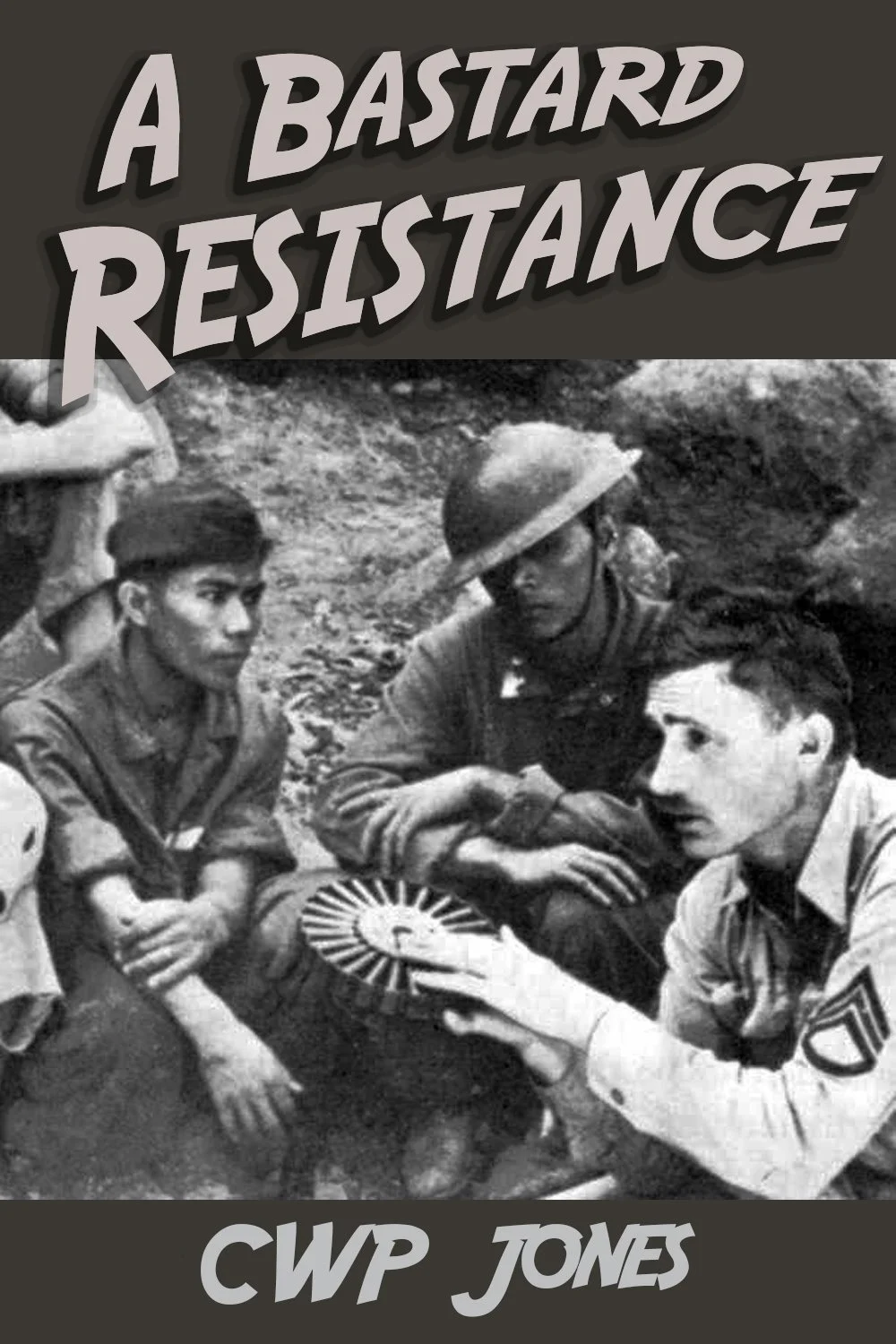
A Bastard Resistance
(Place-holder cover design)
A Bastard Resistance is the story of the men and women who carried out the greatest resistance movement of the Pacific War. The story also recounts (and perhaps solves) one of the most intriguing mysteries of WWII: why General Douglas MacArthur lost half his air force in the Philippines, destroyed on the ground hours after the attack on Pearl Harbor.
May 1942 – Allied forces on Bataan and Corregidor have been defeated. In one of the darkest moments in American history, 76,000 U.S. and Filipino soldiers are forced to surrender. The Rising Sun flag now flies over the entire Philippine Archipelago.
Yet, almost immediately, Jim Cushing, a “beachcomber” before the war, begins to build a formidable resistance movement. For over three years, Cushing’s outgunned guerrillas fiercely resist a brutal army of occupation while desperately hoping for liberation.
Cushing’s chief lieutenants are Pat Morkan and Carmen Duran. Morkan, a wise-cracking New York lawyer and fighter pilot, witnesses the destruction of MacArthur’s air force, despite pleas from his subordinates to launch a strike against the Japanese following the attack on Pearl Harbor. When Morkan’s own plane is later shot down over the Island of Cebu, he comes upon a secret order that may explain why MacArthur failed to get his planes airborne. Morkan then joins the Cebu guerrillas as Cushing’s intelligence chief, confessor and consiglieri.
Duran, devout and driven, leaves a religious order to join the guerrillas. She rises through the ranks to become an integral force in the resistance, forming a network of operatives who provide intelligence the guerrillas desperately need. She and Morkan strike up an intense relationship; among their challenges: being officers and lovers; debating sin and sex; trysts in a guerrilla camp.
Cushing, Morkan and Duran rely on guile, guts, and humor to keep the resistance alive while battling the enemy, dealing with an unhinged co-commander, and pleading with a distant and indifferent MacArthur for aid.
Excerpt
1
Manhattan, Lower Broadway, April 20, 1951 - Morning
When I was in the Army, they told us no plan survives first contact with the enemy. They should have also mentioned that no truth survives first contact with a well-oiled public relations offensive. General Douglas MacArthur could have given a compelling seminar on both theories.
Ten days ago, President Truman relieved General MacArthur of command over U.S. and allied forces in Korea. The cause, in a word: insubordination; not a trifling offense. Today the City of New York was throwing the General a boisterous ticker tape parade. It was only mid-morning, but I could already hear the crowds gathering on the streets below. I’d firmly resolved to ignore the festivities. I had my reasons — which went deeper than the current clash between a President and a Five Star General.
*****
I met this reporter toward the end of the War. He told me he’d reviewed the hundred or so dispatches MacArthur sent off while we were fighting on Bataan. By this guy’s count, more than three quarters of MacArthur’s dispatches referred to one, and only one, member of the United States Armed Forces: General Douglas MacArthur. I haven’t read the dispatches, but I’d bet they don’t say a hell of a lot about how he screwed up on Bataan. I suspect they’re more like Caesar’s War Commentaries. Hardly ever a bad word about Caesar.
*****
I worked through the afternoon; not very effectively. I drifted back to my window around five-thirty. Sanitation men swept ticker tape and other detritus from the parade, but the band was still going at it. They’d moved on to Holst’s The Planets. Nice range. I opened the window, went back to my desk. I picked up the only picture in my office: my wife holding our two kids at Jones Beach, gently introducing them to the surf. They’re nervous as hell, but she’s got this magnificent, nurturing smile, letting them and the rest of the world know, “As long as I hold you, no harm will come.” I wished I could hold them all and make that promise. Maybe the best I could do was simply not look for trouble.
I opened my bottom drawer, fished out a yellowing envelope. No need to re-read the contents. I put the envelope in my ashtray, grabbed my cigarette lighter. I’d gotten used to this lighter over the years, so much so that I rarely noticed the monogram: “20th Pursuit Squadron.” Today I noticed. The memory floodgate began to lift. Cushing had been too much of a gentleman to mention one final outrage MacArthur had visited upon us toward the end of the War. I’d never told my wife about that. I glanced back at the picture. Enough. Time to move on. I flicked open the lighter.
The band started up the Battle Hymn of the Republic. Jesus, but didn’t those bastards have a great sense of timing. I wondered if they knew the lyrics we’d sung on Bataan:
“Dugout Doug MacArthur lies a shaking on the Rock,
Safe from all the bombers and from any sudden shock,
Dugout Doug is eating of the best food on Bataan,
And his troops go starving on.
Dugout Doug’s not timid, he’s just cautious, not afraid,
He’s protecting carefully the stars that Franklin made,
Four-star generals are rare as good food on Bataan,
And his troops go starving on.
Dugout Doug is ready in his Kris Craft for the flee,
Over bounding billows and the wildly raging sea,
For the Japs are pounding on the gates of Old Bataan,
And his troops go starving on…”
I cursed the band.